
Feb 3, 2026
WCBP 2026: Why Comparability is a Challenge for Late-Stage Biopharma
WCBP 2026 highlights why comparability is now the key late-stage challenge, from analytical CQA assessment to regulatory expectations and CMC strategy.
 \
\
The World Conference on Biopharmaceutics and Biopharmaceuticals (WCBP) 2026, organized by CASS, took place in Washington, DC and brought together more than 500 participants from across the global biopharma ecosystem.
Regulators from the FDA and seven other agencies across Europe, Latin America, Africa, Canada, and Japan joined late-stage biopharma teams, primarily from CMC functions, alongside CROs, CDMOs, and analytical instrument providers. The dominant profile was clear: companies close to approval or managing post-approval commitments. The conference focused on dealing with change during the late-stages of drug development.
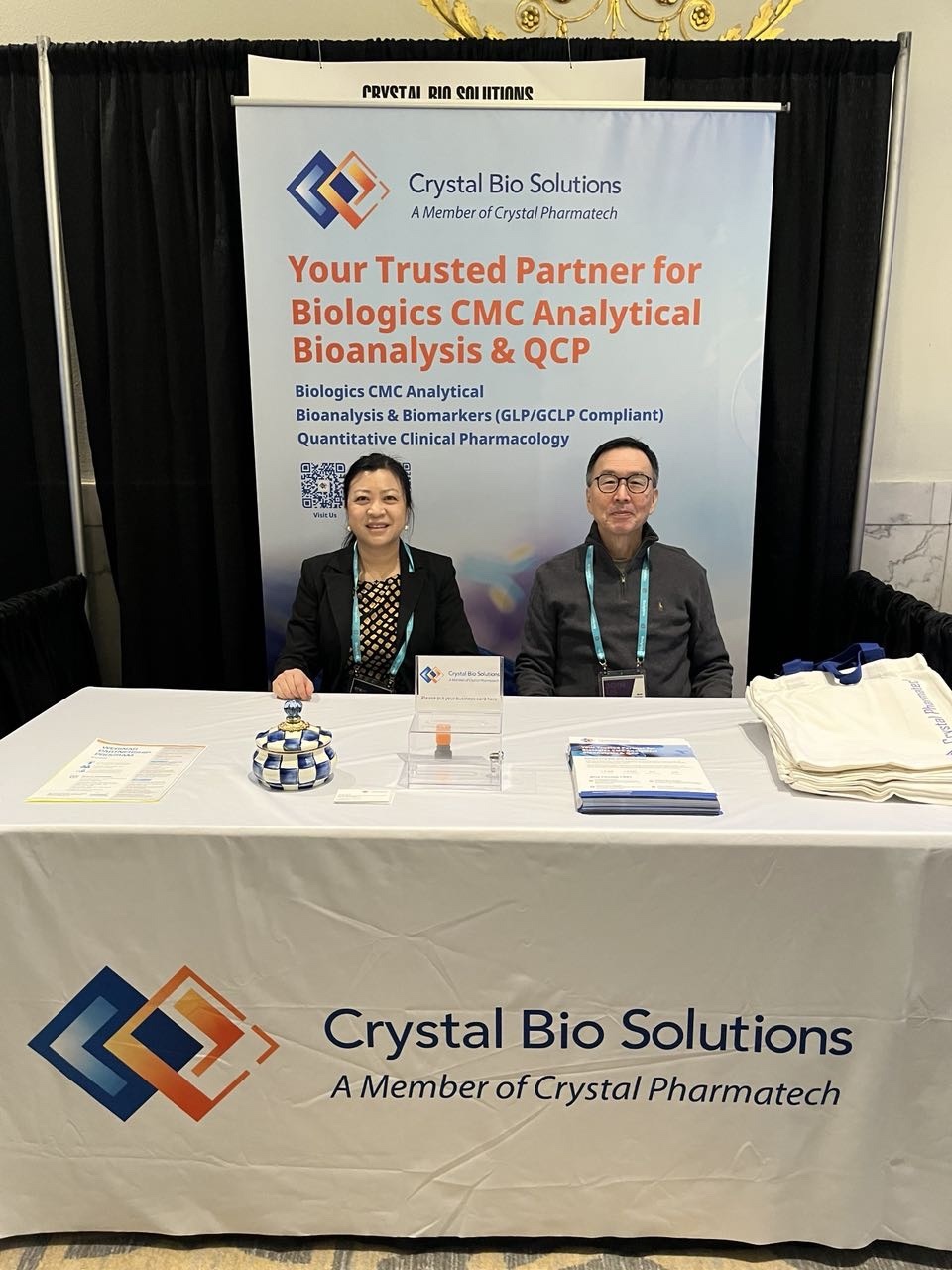
Crystal Bio Solutions was represented at WCBP 2026 by Ye Gu, Chief Technical Officer, left, and Billy Wu, Chief Scientific Officer, right, who attended the conference and shared their insights.
From developability to comparability
WCBP 2026 confirmed a sharp distinction between early-stage and late-stage priorities. Early development focuses on developability. Late development and post-approval focus on comparability.
At this stage, the central question is no longer whether a molecule works, but whether changes to manufacturing, formulation, site, scale, or process can be justified without restarting development. This shift explains why comparability dominated nearly every scientific and regulatory discussion at the conference.
Analytical comparability as the CMC bottleneck
Within the CMC track, analytical comparability emerged as the main constraint for late-stage programs, including biosimilars and originator products. Two technical requirements repeatedly surfaced as the gating factors for successful comparability:
-
Analytical methods capable of assessing CQA impact
Methods must be sensitive and specific enough to detect meaningful changes in critical quality attributes. Superficial similarity is not sufficient. Regulators expect methods that directly link analytical signals to product quality and function.
-
Sufficient numbers of representative lots
Statistical confidence matters. Without enough lots, even strong analytical methods cannot support meaningful conclusions. Limited datasets weaken comparability arguments, especially when variability is intrinsic to the product.
These challenges are operational and resource-intensive, and they often appear late, when timelines and flexibility are already constrained.
Regulatory signals: faster paths, unchanged expectations
One of the most discussed moments of the conference was the keynote from FDA Commissioner Marty Makary, who outlined potential regulatory shifts aimed at accelerating development. These included reduced reliance on animal toxicology studies, fewer required clinical studies for biosimilars, faster agency response times, and shorter overall development timelines.
However, follow-up discussions with FDA officials added essential context. While procedural timelines may shorten, scientific expectations remain unchanged. Regulators continue to require:
- Clear understanding of the molecule
- Defined structure–function relationships
- Demonstrated impact of CQAs
- Strong process understanding and control
Any post-change product must still be shown to be “highly comparable” or “highly similar.” If that standard is not met, traditional development requirements still apply.
What late-stage pipelines look like today
The companies closest to approval or operating in post-approval space shared several common characteristics. Most programs were antibody-based modalities, reflecting the maturity of this class and its continued dominance in late-stage pipelines. A strong trend toward high-concentration formulations, often exceeding 100 mg/mL, was evident across multiple discussions. Alongside this trend, acidic variant variability repeatedly emerged as a critical issue. As concentrations increase, managing heterogeneity becomes more challenging, and its impact on comparability becomes harder to ignore.
How Crystal Bio Solutions supports comparability-driven programs
The themes at WCBP 2026 closely align with the challenges Crystal Bio Solutions works on every day.For late-stage and post-approval programs, CBS supports biopharma teams by:
-
Designing and executing fit-for-purpose analytical strategies
CBS develops and applies advanced analytical methods that directly address CQA sensitivity, enabling meaningful assessment of process and formulation changes.
-
Supporting statistically robust comparability packages
From study design to data interpretation, CBS helps ensure lot selection and dataset depth support defensible, regulator-ready conclusions.
-
Enabling biosimilar and post-change comparability
CBS combines deep analytical expertise with regulatory awareness to support “highly similar” and “highly comparable” claims across global markets.
-
Addressing high-concentration and heterogeneity challenges
CBS has extensive experience with antibody products, including the characterization and control of acidic variants and other sources of variability.
-
Aligning science with regulatory expectations
As regulatory pathways evolve, CBS helps clients translate flexibility into action without compromising scientific rigor.
A clear takeaway from WCBP 2026
WCBP 2026 delivered a consistent message. Regulators are willing to move faster, but only when the data support it. Comparability is no longer a procedural step. It is a decisive scientific demonstration that determines whether late-stage programs advance smoothly or stall.
For biopharma teams approaching the finish line, success now depends less on speed and more on analytical depth, statistical confidence, and a clear understanding of product quality.

Review by Crystal Bio Solutions technical team. February 2, 2026.