
Sep 16, 2025
Immunophenotyping to identify peripheral lymphocyte subsets
Discover how our experts developed FACS-based immunophenotyping method to monitor T and NK cell populations in solid tumor treatment studies.
 \
\
Changes in lymphocyte subpopulations during drug treatment provide valuable insights into pharmacodynamics, safety, and efficacy. Immunophenotyping plays a critical role in modern clinical research, with applications ranging from cancer diagnosis to monitoring immune function in HIV and other diseases. Our expert team at Crystal Bio Solutions designs and validates advanced immunophenotyping methods to track immune responses with precision and reliability.
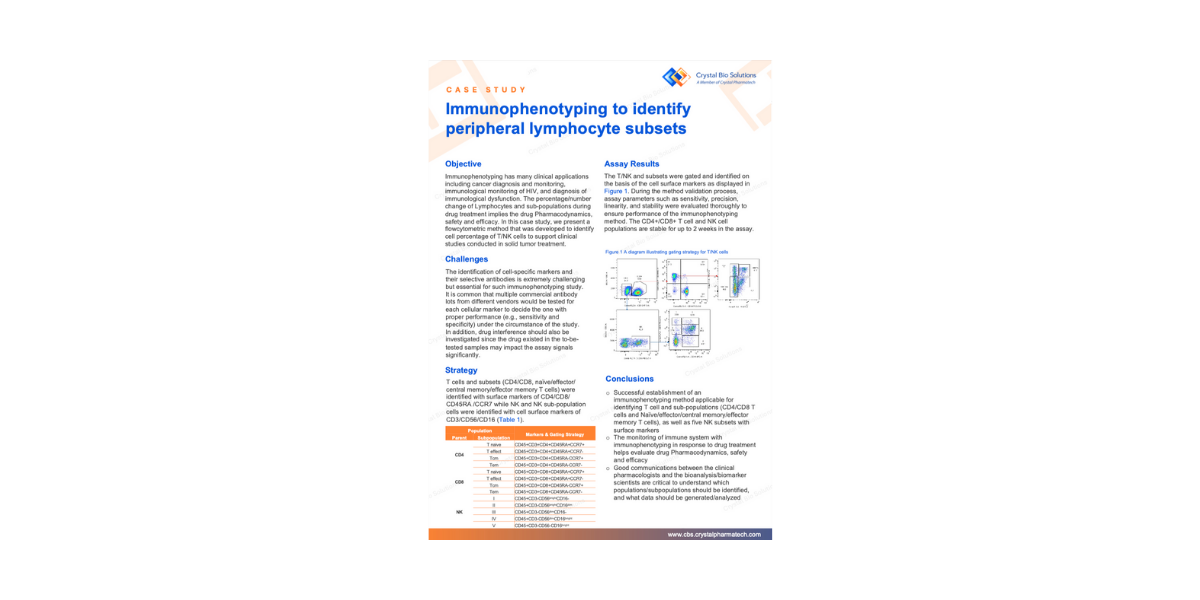
By establishing a robust flow cytometric assay, we successfully identified and monitored T cell subsets (CD4/CD8, naïve, effector, central memory, effector memory) and five NK cell subpopulations, enabling a more complete picture of immune system modulation during treatment.
The Challenge of Immunophenotyping in Clinical Research
Identifying the right cell-specific markers and selective antibodies is both essential and challenging in immunophenotyping. Each marker may require testing across multiple antibody lots and vendors to ensure sensitivity and specificity. Additionally, potential drug interference must be assessed, as therapeutic compounds present in clinical samples can significantly affect assay signals.
Developing a Flow Cytometry Method for T/NK Monitoring: A Case Study
In this project, our experts designed a method using surface markers to distinguish NK cell subpopulations. These markers provided the foundation for a gating strategy that enabled precise identification of:
-
CD4 and CD8 T cell subsets (naïve, effector, central memory, effector memory)
-
Five NK subpopulations with distinct phenotypic profiles
Reliable T and NK Cell Monitoring in Solid Tumor Studies
The validated method demonstrated strong performance across key assay parameters including sensitivity, precision, linearity, and stability. Importantly, CD4+/CD8+ T cell and NK cell populations were stable for up to two weeks, confirming the method’s robustness for clinical applications.
Why Immunophenotyping Matters in Drug Development
Accurate monitoring of immune cell populations is vital for evaluating how new therapies interact with the immune system. Immunophenotyping provides actionable data on pharmacodynamics, safety, and efficacy, helping drug developers better understand treatment effects and guide clinical decision-making.
Key Takeaways
-
We successfully established a flow cytometric immunophenotyping method for T and NK subsets
-
Monitoring immune responses provides critical insights into drug pharmacodynamics, safety, and efficacy
-
Close collaboration between clinical pharmacologists and bioanalysis/biomarker scientists ensures that the right subpopulations are monitored and the most relevant data are generated
📥📎 Access the case study