

CBS Logo
CRO Can Help Antibody–Drug Conjugates Development

How a CRO Can Help Antibody–Drug Conjugates Development

A skilled partner, such as CRO or a CRDMO, should provide the analytical depth, cross-functional expertise, and regulatory alignment required to advance an ADC program from early discovery to an IND submission with confidence.

Antibody–drug conjugate development requires close coordination across multiple scientific disciplines. Each component of the molecule behaves differently during circulation, degradation, and payload release, creating a level of complexity that is difficult to manage internally.


Most organizations cannot advance these programs alone and benefit greatly from partnering with a qualified CRO or CRDMO.


A strong partner provides more than individual assays. It offers troubleshooting support, process optimization, and the technical insight needed to understand the molecule and guide its progression with confidence. This support typically includes:


  • Advanced analytical chemistry

  • Integrated bioanalysis for both antibody and payload

  • Comprehensive biomarker strategies

  • CMC characterization and manufacturing controls

  • Quantitative clinical pharmacology for dose selection

  • Regulatory guidance from early discovery to IND


Without this integrated support, ADC programs risk delays, gaps in data continuity, and challenges during regulatory review.

Bioanalysis of Antibody–Drug Conjugates


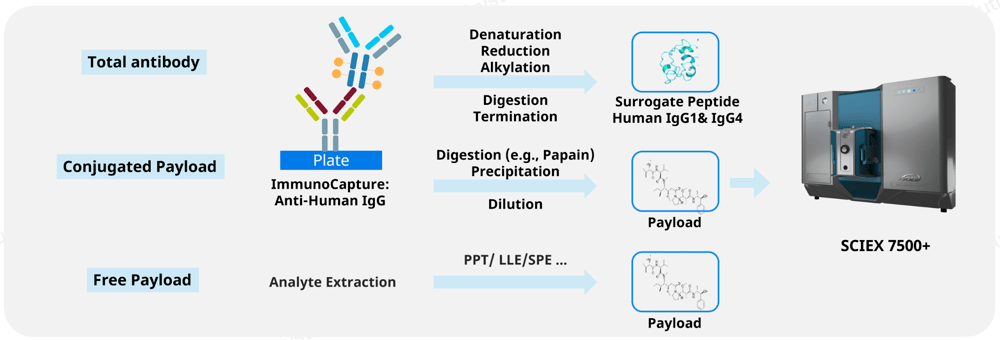
Bioanalysis is at the center of every ADC program. It describes how the ADC moves through the body, how it releases its payload, and how long active species remain in circulation.


A CRO should develop and validate methods such as:


  • LC–MS/MS methods for free and conjugated payload

  • Ligand-binding assays for total and conjugated antibody

  • Hybrid LBA–MS approaches for drug-to-antibody ratio (DAR) and stability tracking

  • Assay platforms that remain consistent from nonclinical to clinical phases


These data create a clear view of exposure, clearance, and payload release across species and time points. Read more about Strategies for Antibody–Drug Conjugates Bioanalysis

Crystal-Bio-Solutions-Antibody-Drug-Candidate-Bioanalysis

Biomarker Development for ADC Programs


Biomarkers analysis connect ADC exposure to biological activity. They provide early signals of response, inform dose selection, and support proof of mechanism. A CRO helps identify and validate biomarkers that reflect both payload effects and immune responses.


Examples of CRO biomarker support include:


  • Flow cytometry and ELISpot for immune profiling

  • Molecular assays such as qPCR or RNA-seq to monitor gene expression

  • Pharmacodynamic biomarkers that correlate payload delivery with cell death or immune modulation


These data inform dose selection, patient stratification, and early proof of mechanism.

Manufacturing and Control of Antibody-Drug Conjugates


Chemistry, Manufacturing, and Controls (CMC) activities define the identity, purity, and stability of the ADC. Only highly experienced CROs can ensure that the product remains consistent across the entire development lifecycle, including all batches and study stages.


They protect the program from unexpected variability and provide the foundation for regulatory submissions. Key analytical elements include:


  • DAR and distribution analysis

  • Linker stability studies under physiological and stressed conditions

  • Conjugation site mapping and structural assessments

  • Forced degradation and lot-to-lot comparability


A robust CMC dataset demonstrates product reproducibility and supports regulatory submissions from IND to BLA.

Quantitative Clinical Pharmacology (QCP)


Quantitative modeling is therefore essential for predicting clinical performance. ADCs follow complex pharmacokinetic pathways due to multiple elimination routes and controlled payload release, to predict success CROs should:


  • PK and PD modeling for antibody, conjugated species, and free payload

  • Translation of nonclinical data to first-in-human dosing

  • Simulation of dose schedules to balance efficacy and safety

  • Exposure–response analysis for regulatory justification


These quantitative frameworks strengthen dose rationale and support adaptive trial design.

Translational and Regulatory Support in Biologics


Preparation for FDA or EMA review is one of the most demanding phases of ADC development. Consistent alignment across all scientific functions is essential.


The right CRO integrates data from bioanalysis, CMC analytics, biomarkers, and quantitative modeling to build a clear and coherent regulatory narrative. This work includes:


  • Documentation aligned with ICH M10, GLP, and GCP

  • Validation reports and stability packages

  • Integrated summaries linking exposure, activity, and safety


A coordinated approach ensures that regulators receive well supported and clearly presented evidence of product quality and performance.

How to Choose the Right ADC Development Partner


Selecting the appropriate developmental partner is essential for the success of any ADC program. A strong partner should demonstrate:


  • Deep expertise in both biologics and small-molecule analytics

  • Proven capability in dual-analyte bioanalysis and DAR characterization

  • Robust CMC infrastructure for stability, degradation, and comparability studies

  • Competence in biomarker development and translational strategy

  • Established quantitative pharmacology and modeling experience

  • Clear familiarity with global regulatory expectations for ADCs


At Crystal Bio Solutions, we have developed 300+ successful ADC projects, ensuring scientific continuity, regulatory readiness, and reliable progression from discovery to clinical development.

 

Read more about us


Case Study: A Generic LC-MS/MS Solution for ADC PK Bioanalysis