
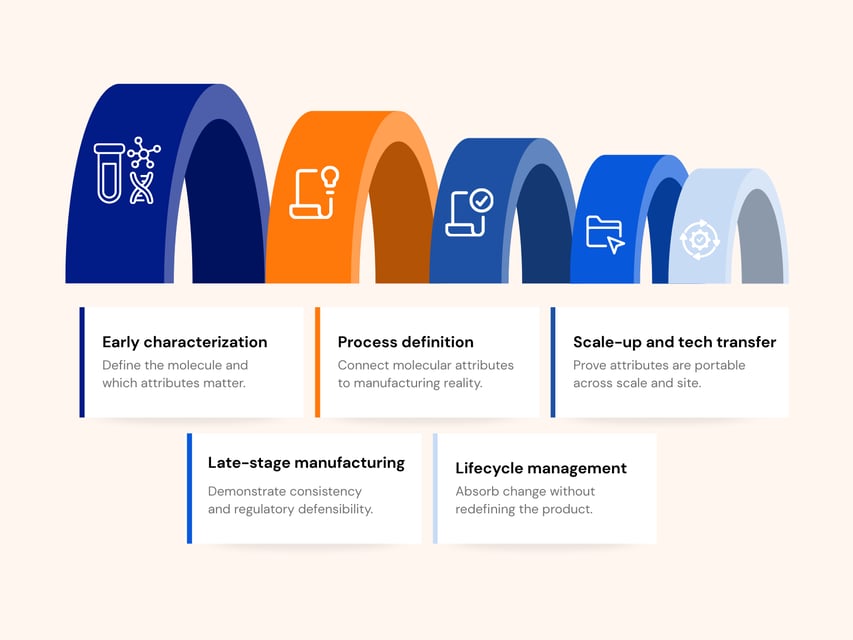
CMC Analytical Readiness for Biologics
CMC readiness determines whether biologic programs can absorb change without losing regulatory credibility across development and lifecycle stages.
Chemistry, Manufacturing, and Controls (CMC) analytical readiness determines whether a biologic program can absorb change without losing regulatory credibility. When analytical characterization is incomplete or poorly aligned with development decisions, stability interpretation, comparability assessments, and regulatory review become fragile at the moment coherence is most required.
This page explains:
-
How CMC analytical characterization defines what a biologic product is and how confidently it can be controlled
-
Which molecular attributes most strongly affect stability, comparability, and regulatory interpretation
-
How early analytical decisions influence flexibility during process change and scale-up
-
How regulators evaluate CMC analytical packages as integrated scientific arguments
This page is written for CMC and analytical development leads, process development scientists, quality and manufacturing teams, and regulatory affairs leads working on biologics, including monoclonal antibodies, Fc-fusion proteins, antibody-drug conjugates, oligonucleotides, messenger RNA formulations, and viral vector intermediates.
Why CMC analytical readiness determines program stability
CMC characterization is the set of methods used to define, measure, and control the molecular attributes of a biologic drug substance and drug product throughout CMC analytical development. These attributes include identity, heterogeneity, purity, potency, stability, and critical quality attributes.
CMC analytics readiness is achieved when analytical data remain interpretable, comparable, and scientifically defensible as manufacturing processes, scale, formulation, and clinical use change.
But biologics are not single molecular entities. They are distributions of molecular forms shaped by expression systems, purification processes, formulation, and storage. As a result, CMC analytics do more than describe the product. They define the boundaries within which change can be justified.
When characterization depth is insufficient or disconnected from development decisions, analytical uncertainty accumulates silently. This uncertainty often surfaces late, during comparability assessments, stability failures, or regulatory review, when corrective options are limited.
Before locking key processes, developers should test whether each major quality attribute can be explained mechanistically if it shifts. A structured CMC gap analysis at this stage identifies which attributes lack sufficient characterization depth before they become a liability during comparability or regulatory review.
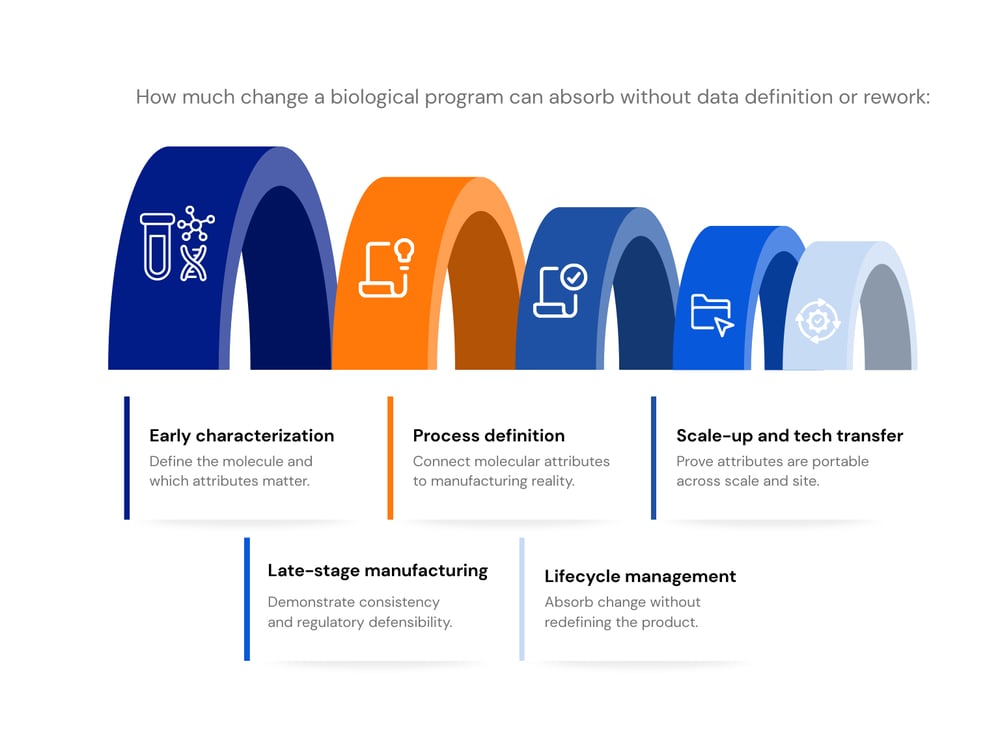
CMC stages across biologics
Across biologic development, CMC does not progress as a linear checklist of completed tasks. It evolves through a set of stages in which analytical decisions accumulate meaning and progressively constrain or enable future change.
The main CMC stages are:
-
Early characterization, where the initial molecular baseline is established and key attributes are first identified.
-
Process definition, where molecular attributes are connected to expression systems, purification steps, and formulation choices.
-
Scale-up and technology transfer, where attribute behavior must remain interpretable across scale, site, and operational variability.
-
Late-stage manufacturing, where consistency, historical performance, and regulatory defensibility become central.
-
Lifecycle management, where post-approval changes must be justified without redefining the product.
Across all these stages, the same five analytical dimensions are continuously present: identity and molecular integrity, heterogeneity and variant distributions, potency and functional relevance, stability and degradation pathways, and critical quality attributes and control strategy.
These dimensions do not appear once and then close. They deepen, lock in, and gain regulatory weight as development progresses. CMC analytical readiness is achieved when these dimensions are understood early enough, and with sufficient mechanistic depth, that they remain interpretable and defensible as processes change, scale increases, and the product moves through its full lifecycle.
This staging and dimensional framework is aligned with international regulatory guidance, including ICH Q8, Q9, Q10, Q11, and Q5E, as well as regulatory expectations for analytical characterization, comparability, and lifecycle management of biological products.
Core CMC characterization dimensions that drive readiness
These dimensions are evaluated through complex biologics characterization services that apply orthogonal methods across identity, heterogeneity, potency, stability, and post-translational modifications, covering the full CQA landscape required for regulatory submission.
1. Identity and molecular integrity
Identity confirmation in biologics extends beyond nominal sequence verification. Low-level variants, truncations, misincorporations, and chemical modifications can influence functional behavior, stability, and downstream interpretation.
If identity characterization is superficial, later differences may be detected without a clear baseline for interpretation, weakening comparability arguments.
2. Heterogeneity, variants, and distributions
Charge variants, size variants, and post-translational modifications are intrinsic to biologics. The regulatory question is not whether heterogeneity exists, but whether it is understood, controlled, and scientifically justified.
At CBS, we apply a risk-based critical quality attribute framework, particularly in complex modalities such as antibody-drug conjugates, where not all attributes contribute equally to product risk. We discuss this approach is detailed in critical quality attributes in antibody-drug conjugates.
3. Aggregation and degradation pathways
Aggregation and degradation are often framed as stability concerns, but they also represent comparability and interpretation risks. Attribute drift that remains within specifications can still complicate change assessments if degradation pathways are not understood.
Early forced degradation studies allow teams to anticipate how attributes respond to stress, storage, and formulation changes.
4. Post-translational modifications and conjugation heterogeneity
Post-translational modifications such as oxidation and deamidation can alter binding, clearance, and stability. In antibody-drug conjugates (ADCs), conjugation heterogeneity introduces additional complexity through drug-to-antibody ratio distributions and unconjugated antibody species.
Our analytical evaluations show that unconjugated antibody (D0 species) is not a benign impurity. If not characterized and trended appropriately, it can act as a functional competitor and complicate interpretation during development and change.
Stability, comparability, and change awareness
Stability programs are design tools that reveal which attributes are sensitive to time, temperature, and formulation. Comparability is similarly cumulative, reflecting how well attributes were characterized before change occurred.
When stability and comparability are treated as downstream obligations, flexibility is lost. When they are built into the CMC strategy, change becomes manageable.
Common CMC risks and how mitigate them
| Observed challenge | Underlying CMC cause | Readiness-aligned mitigation |
|---|---|---|
| Unexpected differences after process change | Incomplete attribute resolution | Orthogonal characterization and early trending |
| Fragile comparability arguments | Qualitative heterogeneity assessment | Quantitative distributions with reference history |
| Late regulatory questions | Unclear scientific rationale | Integrated narrative linking data to risk |
| Limited flexibility during scale-up | Stability viewed as confirmatory only | Stress-informed design and pathway mapping |
Regulatory-ready documentation and GMP execution
Regulatory agencies assess CMC gap analysis. Reviewers expect clear rationale for attribute selection, transparent discussion of variability, and consistency across development stages.
CMC readiness also includes execution elements required for early clinical manufacturing. We support sterility assessment and microbiological control strategies aligned with regulatory expectations, ensuring analytical packages reflect both molecular quality and manufacturing reality.
How CMC connects to bioanalysis
CMC analytical characterization defines the molecular reality of the product. Clinical bioanalysis measures that product in biological systems under drug presence and matrix complexity.
When these domains are designed independently, inconsistencies emerge. When they are designed coherently, clinical data remain interpretable as programs evolve.
Frequently asked questions
What is CMC analytical readiness in biologics?
CMC analytical readiness means having a characterization package that remains interpretable and defensible as manufacturing processes, formulation, scale, and clinical use evolve. It is not a single milestone. It is a cumulative state in which each analytical decision made during development continues to support future comparability, stability, and regulatory arguments without requiring rework.
Why do CMC issues often appear late in development?
Analytical uncertainty accumulates silently during early development when characterization depth is insufficient or disconnected from process decisions. The gaps become visible only during comparability assessments, stability failures, or regulatory review, when corrective options are limited and timelines are compressed.
What is a CMC gap analysis and when should it be done?
A CMC gap analysis is a structured evaluation of which quality attributes lack sufficient characterization, method validation, or regulatory justification relative to the current development stage. It should be conducted before IND submission, before major process changes, and before technology transfer. Identifying gaps early preserves flexibility and reduces the risk of late-stage surprises.
Are all quality attributes equally critical?
No. Regulatory guidance, including ICH Q8 and FDA expectations for biologics, requires risk-based prioritization of critical quality attributes. Attributes are assessed based on their potential impact on safety, efficacy, and stability. Not every attribute requires the same depth of characterization or control, but the scientific rationale for each prioritization decision must be documented and defensible.
How early should stability studies be designed?
Stability programs should be designed as soon as formulation and process decisions begin to solidify, not only in preparation for filing. Early forced degradation studies allow teams to map degradation pathways and anticipate how attributes respond to stress, storage, and formulation changes. This information directly informs comparability strategy and specifications.
Why are orthogonal methods important in CMC analytical development?
Orthogonal methods measure the same attribute through different physicochemical principles, reducing the risk of blind spots that arise when a single technique is relied upon exclusively. Regulators expect orthogonal characterization for critical quality attributes, particularly for complex modalities such as ADCs, where charge variants, size variants, and conjugation heterogeneity require independent confirmation.
When does CMC analytical characterization require external expert support?
External support is appropriate when internal teams encounter modality complexity beyond current in-house capabilities, when novel mechanisms or unexpected variability limits interpretation, or when regulatory submissions require validated methods and documented scientific rationale that exceed available bandwidth. Early engagement with a specialized CRO reduces the risk of analytical gaps accumulating undetected.
How does CMC analytical readiness connect to bioanalysis?
CMC characterization defines the molecular identity and quality of the drug substance. Bioanalysis measures that substance in biological systems under matrix complexity and drug presence. When these domains are designed independently, inconsistencies in method assumptions, reference standards, or attribute definitions can complicate clinical data interpretation. When they are aligned from early development, both packages remain coherent as programs progress.
Reviewed by Crystal Bio Solutions Scientific Marketing Team, March 2026
References
ICH Q6B. Specifications: Test Procedures and Acceptance Criteria for Biotechnological/Biological Products. International Council for Harmonisation of Technical Requirements for Pharmaceuticals for Human Use. https://www.ema.europa.eu/en/ich-q6b-specifications-test-procedures-acceptance-criteria-biotechnological-biological-products-scientific-guideline
ICH Q5E. Comparability of Biotechnological/Biological Products Subject to Changes in Their Manufacturing Process. International Council for Harmonisation. https://www.ema.europa.eu/en/ich-q5e-comparability-biotechnologicalbiological-products-subject-changes-their-manufacturing-process-scientific-guideline
ICH Q5C. Stability Testing of Biotechnological/Biological Products. International Council for Harmonisation. https://www.ema.europa.eu/en/ich-q5c-stability-testing-biotechnological-biological-products-scientific-guideline
ICH Q8(R2). Pharmaceutical Development. International Council for Harmonisation. https://www.ema.europa.eu/en/ich-q8-r2-pharmaceutical-development-scientific-guideline
ICH Q9(R1). Quality Risk Management. International Council for Harmonisation. https://www.ema.europa.eu/en/ich-q9-quality-risk-management-scientific-guideline
ICH Q10. Pharmaceutical Quality System. International Council for Harmonisation. https://www.ema.europa.eu/en/ich-q10-pharmaceutical-quality-system-scientific-guideline
ICH Q11. Development and Manufacture of Drug Substances. International Council for Harmonisation. https://www.ema.europa.eu/en/ich-q11-development-manufacture-drug-substances-scientific-guideline
U.S. Food and Drug Administration. Analytical Procedures and Methods Validation for Drugs and Biologics: Guidance for Industry. FDA; 2015. https://www.fda.gov/files/drugs/published/Analytical-Procedures-and-Methods-Validation-for-Drugs-and-Biologics.pdf
U.S. Food and Drug Administration. Guidance for Industry: Q1A(R2) Stability Testing of New Drug Substances and Drug Products. FDA. https://www.fda.gov/regulatory-information/search-fda-guidance-documents/q1ar2-stability-testing-new-drug-substances-and-drug-products
Berkowitz SA, Engen JR, Mazzeo JR, Jones GB. Analytical tools for characterizing biopharmaceuticals and the implications for biosimilars. Nature Reviews Drug Discovery. 2012;11(7):527–540. https://www.nature.com/articles/nrd3746
Case Study: A Generic LC-MS/MS Solution for ADC PK Bioanalysis