

Biologics Characterization and CMC Analytical Services
We design analytical strategies that stay clear and interpretable as your process scales and regulatory expectations evolve. We support monoclonal antibodies, antibody drug conjugates, recombinant proteins, bispecific antibodies, biosimilars, and nucleic acids from early development through clinical stages.



How Regulators Evaluate Biologics CMC
During IND and BLA review, agencies assess whether analytical data clearly define and control critical quality attributes.
Review focuses on whether attributes are:
- Scientifically sound and reliably measurable using qualified or validated analytical methods
- Controlled within clearly defined and defensible limits
- Mechanistically interpretable across the product lifecycle, including after manufacturing changes
Analytical gaps often trigger information requests when impurity limits lack justification, stability trends are unclear, or structural heterogeneity is insufficiently characterized.
To avoid that, analytical strategies should be defined early, supported by orthogonal methods, and aligned with a clear control framework that links structure, function, and manufacturing consistency.


When Programs Need an Expert on Biologics CMC
Development teams typically engage us when:
- Preparing or defending CMC packages during IND submission and regulatory interactions
- Managing manufacturing changes, comparability exercises, or biosimilar similarity strategies
- Investigating complex analytics, such as stability or heterogeneity
- Transitioning from early development into clinical stage manufacturing
Our role is to determine whether the current analytical framework can withstand regulatory scrutiny. If not, we reinforce it by clarifying critical quality attributes, closing analytical gaps, strengthening control strategies, and structuring comparability data, so it remains scientifically coherent and defensible during review.

Crystal Bio Solutions Analytical Capabilities
Crystal Bio Solutions (CBS) operates a dedicated 5,300 sq ft CMC analytical laboratory in New Jersey supporting manufacturing and characterization through clinical stages. Key platforms and methodologies include:
| Chromatographic Techniques | Electrophoretic & Biophysical Methods | High-Resolution Mass Spectrometry |
| Size-exclusion chromatography (SEC) for aggregation analysis | Capillary Electrophoresis SDS (CE-SDS) for purity and fragmentation | Intact mass confirmation and PTM and glycan profiling |
| Ion exchange chromatography (IEX) for charge variant profiling | Dynamic light scattering (DLS) for particle sizing | Peptide mapping and sequence coverage |
| Hydrophobic interaction chromatography (HIC) for ADC characterization | Differential scanning calorimetry (DSC) for thermal stability | Charge variant mapping |
| Reverse-phase chromatography (RP) for purity assessment | UV and fluorescence spectroscopy for structural monitoring | Drug-to-antibody ratio (DAR) determination for ADCs |
| FTIR for secondary structure assessment |
How to Characterize Antibody-based Drugs
Monoclonal antibodies and antibody-derived formats require structured analytical control due to their inherent heterogeneity. Biologic characterization and CMC define the molecule through sequence confirmation, structural variant mapping, impurity control, and stability assessment, establishing the critical quality framework reviewed during IND and BLA evaluation.
Teams often struggle when critical quality attributes are not clearly defined early. This typically happens when development timelines compress early analytical work or when CQAs are defined only after manufacturing scale-up. In antibody-drug conjugates, there is an added complexity such as drug-to-antibody ratio distribution, conjugation variability, and payload stability. The result can be unstable comparability after process changes, unexpected immunogenicity signals or regulatory information requests during regulatory review.
A Generic LC-MS/MS Solution for ADC PK Bioanalysis
Critical Quality Attribute (CQA) in Antibody Drug Conjugate (ADC) Modality
..png?width=600&height=460&name=ADC%20structure%20(adopted%20from%20Signal%20Transduction%20and%20Targeted%20Therapy)..png "ADC structure (adopted from Signal Transduction and Targeted Therapy).")
Keys to Biosimilar Drug Development
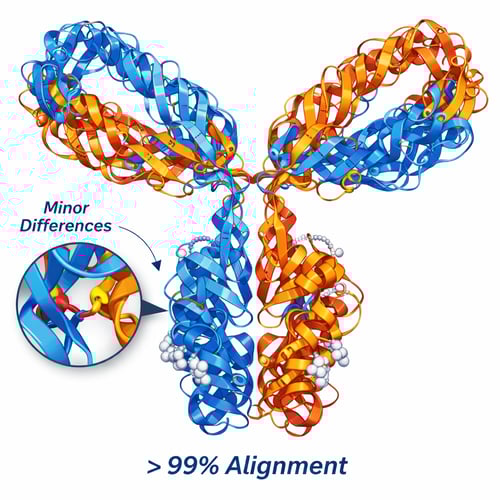
Biosimilar drugs are biologic medicines developed to be highly similar to an approved reference product, with no clinically meaningful differences in safety, purity, or potency. Recent FDA approvals show a clear direction: analytical similarity now drives biosimilar development, with reduced reliance on large comparative efficacy trials when structural and pharmacokinetics (PK) evidence is strong.
However, projects often present incomplete glycan characterization, weak functional assay design, and poorly justified similarity ranges, which can trigger FDA information requests, delay PK studies, force repeat analytical work, narrow similarity margins, or ultimately require additional clinical confirmation, increasing cost and extending approval timelines.
What Does the FDA Require to Approve a Monoclonal Antibody Biosimilar in 2026?
The 6 Most Common Analytical Gaps in Biosimilar Programs (and how to fix them)
Frequently Asked CMC Questions
How does CMC analytical development influence IND review timelines?
Incomplete structural definition, poorly justified impurity limits, or unclear stability interpretation frequently generate regulatory information requests. Early alignment of analytical data with regulatory expectations reduces submission risk and review delays.
When does a manufacturing change require expanded comparability analysis?
Changes in scale, cell line, purification steps, raw materials, or formulation can affect critical quality attributes. Expanded orthogonal characterization is required when attribute variability increases or process risk shifts.
What level of analytical similarity is expected for biosimilars?
Regulators expect extensive structural and functional similarity supported by orthogonal methods and statistical evaluation. Analytical data must justify reduced clinical burden within the totality-of-evidence framework.
What differentiates method development from analytical strategy?
Method development generates data. Analytical strategy defines which attributes matter, how they are justified, and how they support regulatory conclusions.
Characterize your molecule and avoid surprises during IND/BLA reviews