Regulatory momentum toward analytical evidence for biosimilar drugs
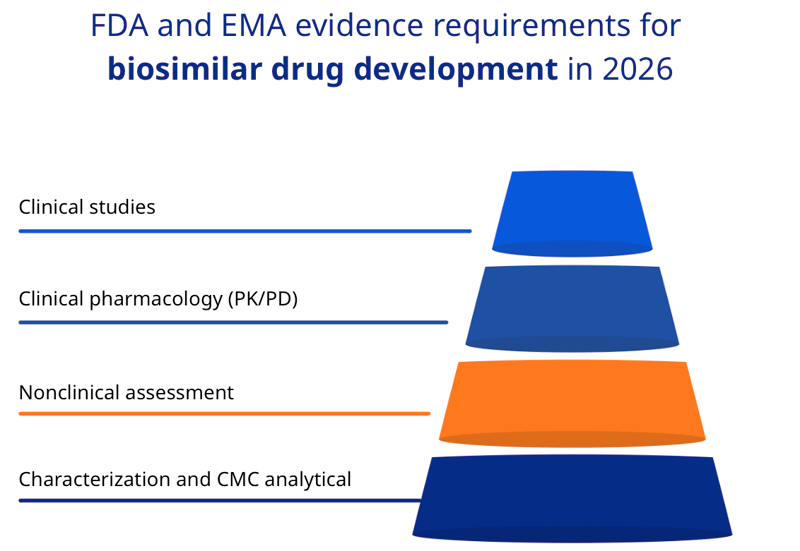
Regulators are changing how they evaluate biosimilar drugs. Both U.S. Food and Drug Administration (FDA) and European Medicines Agency (EMA) agencies clearly signal a move toward analytically driven biosimilar approval, with increasing alignment across regions.
In April 2025, the EMA released a draft reflection paper (for public consultation) to explore when clinical efficacy data may be de-emphasized in favor of analytical and PK evidence. The paper does not create a formal guideline with regulatory force yet, but it signals EMA’s intent.
Similarly, in October 2025, the FDA released a draft guidance proposes that for many biosimilars, especially well-characterized proteins, the agency may no longer routinely require comparative clinical efficacy studies (CES) if robust analytical and pharmacokinetic data sufficiently demonstrate similarity to the reference product. The draft replaces older expectations by emphasizing comparative analytical assessment (CAA) and targeted PK data, and was published to reduce time/cost burdens on biosimilar developers.
Additionally, in 2025, the FDA finalized a guidance on therapeutic protein biosimilars (focused on comparative analytical studies), which further clarifies current expectations for demonstrating analytical similarity.
| Aspect |
United States (FDA) |
Europe (EMA) |
| Regulatory signal |
Draft guidance (Oct 2025) |
Draft reflection paper (Apr 2025) |
| Role of analytics |
Analytical similarity as the foundation of approval |
Strong analytical & PK evidence supports tailored approach |
| Impact on clinical studies |
Comparative clinical efficacy studies may be reduced |
Clinical requirements may be reduced under defined conditions |
| Interchangeability policy |
Guidance aims to simplify or reduce switching study requirements |
Not centrally addressed; substitution policies vary by member state |
| Objectives |
Streamline development, cut time and cost |
Improve access while maintaining safety standards |
| Status |
Feedback period concluded; guidance moving toward finalization |
Open public consultation until late 2025 |
| Key takeaway |
Analytical similarity is central to biosimilar approval |
EMA is moving toward analytically led biosimilar development |
Interchangeability is a regulatory designation used in the United States that applies to certain biosimilar drugs.
If a biosimilar is designated as interchangeable by the FDA:
-
A pharmacist may substitute it for the reference biologic without contacting the prescriber, depending on state law
-
The patient should expect the same clinical outcome, even if switched back and forth
A clear trend toward regulatory harmonization
Global regulators are converging on analytical excellence as the basis for reducing clinical study requirements for biosimilar drugs. When analytical characterization is deep, orthogonal, and scientifically rigorous, the need for large comparative clinical trials can be significantly reduced without compromising regulatory confidence.